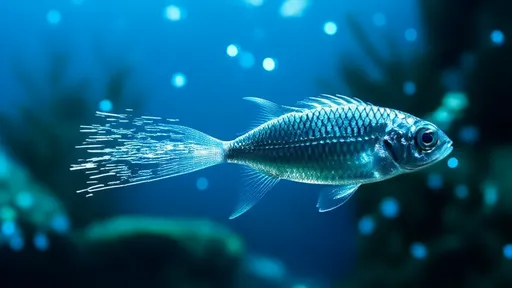
In the lush mangrove forests of Southeast Asia, an unassuming predator performs ballistic calculations that would make a military sniper envious. The archerfish (Toxotes jaculatrix) has mastered the art of shooting down prey with precision water jets – a hunting technique that combines physics, physiology, and evolutionary ingenuity. These aquatic marksmen can hit targets up to 2 meters above the water's surface with millimeter accuracy, compensating for light refraction, gravity, and even moving targets.
The Water Bullet Phenomenon
When an archerfish spots an insect resting on vegetation overhanging the water, it approaches the surface with deliberate calm. In a blink-and-you'll-miss-it motion, the fish forms a narrow tube with its tongue against a groove in the roof of its mouth, then contracts its gill covers to force water through this biological barrel. The result? A high-velocity water bullet traveling at speeds up to 2 meters per second.
What makes this weapon extraordinary isn't just its delivery mechanism, but its intelligent design. The fish can modulate the water jet's power and duration – firing anything from rapid single droplets to sustained streams. Recent high-speed photography reveals that successful shots typically consist of 2-3 droplets, with the second droplet often delivering the knock-out punch by striking the target at maximum velocity.
Nature's Ballistics Computer
The archerfish's neural circuitry performs real-time ballistic calculations that would challenge supercomputers. As light bends when crossing the water-air interface (refraction), the fish must compensate for this visual distortion. Even more impressively, research shows they account for gravity's effect on both their projectile and the falling prey – adjusting their aim point based on target height.
In laboratory experiments, archerfish demonstrated the ability to learn complex targeting patterns. When presented with novel target configurations, they initially miss but rapidly adapt, often achieving 80% accuracy within just 5-6 attempts. This learning curve suggests sophisticated neural plasticity rather than hardwired instinct.
Hydrodynamic Engineering
The water jet itself is a marvel of fluid dynamics. As the droplet travels through air, surface tension maintains its spherical shape while aerodynamic drag gradually slows it. The fish optimizes this trade-off by adjusting the initial velocity – faster for distant targets to overcome drag, slower for closer ones to maintain accuracy.
Biomechanical studies reveal the archerfish's mouth acts like a tunable pressure cannon. By varying the gill cover contraction force and the tongue's positioning, the fish controls the water jet's diameter (typically 0.5-1.5mm) and velocity (1-2 m/s). This adjustability allows hunting everything from delicate mosquitoes to sturdy beetles.
Evolutionary Arms Race
This remarkable adaptation likely emerged from an evolutionary arms race between predator and prey. Insects resting near water surfaces developed better grip and faster reaction times, while archerfish refined their shooting accuracy. Fossil evidence suggests proto-archerfish may have developed this trait as early as the Miocene epoch, some 20 million years ago.
Modern archerfish demonstrate behavioral flexibility that hints at advanced cognition. They've been observed leading shots when targeting moving prey (like flying insects), accounting for both the prey's speed and their projectile's travel time – a calculation that requires predicting future positions.
Scientific and Technological Implications
Researchers are studying archerfish hydrodynamics to improve industrial spray technologies. The precision of their water jets could inspire more efficient inkjet printers, medical drug delivery systems, or even firefighting equipment. Meanwhile, neuroscientists investigate their visual processing as a model for machine vision systems that compensate for refractive distortions.
Perhaps most remarkably, these fish challenge our assumptions about intelligence. Without a cerebral cortex, archerfish perform complex calculations that humans require advanced mathematics to replicate. Their existence suggests that sophisticated problem-solving can evolve through entirely different neural architectures than our own.
Next time you encounter an archerfish in an aquarium, take a moment to appreciate this unassuming genius. In its watery world, physics becomes a weapon, neural networks solve ballistic equations, and a simple drop of water transforms into a precision-guided projectile – nature's perfect synthesis of form, function, and firing solution.

By /Jul 7, 2025

By /Jul 7, 2025

By /Jul 7, 2025

By /Jul 7, 2025

By /Jul 7, 2025

By /Jul 7, 2025
By /Jul 7, 2025
By /Jul 7, 2025
By /Jul 7, 2025
By /Jul 7, 2025

By /Jul 7, 2025
By /Jul 7, 2025

By /Jul 7, 2025

By /Jul 7, 2025
By /Jul 7, 2025

By /Jul 7, 2025
By /Jul 7, 2025
By /Jul 7, 2025
