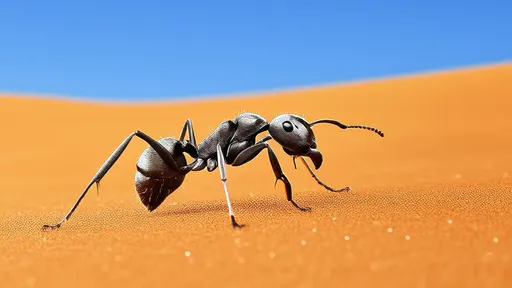
The Sahara Desert is one of the harshest environments on Earth, with scorching temperatures that can exceed 50°C (122°F) during the day. Yet, amidst this unforgiving landscape, a tiny insect thrives where most creatures would perish—the Saharan silver ant (Cataglyphis bombycina). These remarkable ants have evolved extraordinary adaptations that allow them to endure extreme heat, move at blistering speeds, and forage in conditions that would be lethal to almost any other animal.
Known for their striking metallic sheen, Saharan silver ants are among the most heat-resistant creatures on the planet. Researchers have discovered that these ants can withstand surface temperatures of up to 70°C (158°F), a feat that defies the biological limits of most living organisms. Their survival hinges on a combination of physiological, behavioral, and morphological adaptations that have fascinated scientists for decades.
The Silver Shield: A Reflector of Deadly Heat
One of the most distinctive features of the Saharan silver ant is its shimmering, silvery coat. This isn’t just for show—it’s a critical survival tool. The ants’ bodies are covered in dense, triangular hairs that reflect sunlight like a mirror. These hairs are particularly effective at deflecting the near-infrared wavelengths of light, which carry the most heat. By bouncing off a significant portion of solar radiation, the ants reduce the amount of heat absorbed by their bodies, allowing them to stay cooler than their surroundings.
This adaptation is so effective that researchers have studied it for potential applications in human technology, such as designing heat-reflective materials for buildings or spacecraft. The ants’ natural "cooling system" is a masterpiece of evolution, honed over millennia to perfection.
Speed Demons of the Desert
Another astonishing trait of the Saharan silver ant is its incredible speed. These ants are among the fastest in the world relative to their size, clocking in at nearly one meter per second—equivalent to a human running at over 500 kilometers per hour. Their long legs and rapid stride allow them to dart across the scorching sand with minimal contact time, reducing heat absorption from the ground.
This speed isn’t just for show; it’s a necessity. The ants only venture out of their nests during the hottest part of the day, when predators like lizards are forced to seek shade. By operating in this narrow window of extreme heat, they minimize the risk of being eaten. However, this also means they must work quickly—their foraging trips last only about 10 minutes before the heat becomes unbearable, even for them.
Navigating a Fiery Wasteland
Finding food in the vast, featureless desert is no easy task, yet Saharan silver ants have an uncanny ability to navigate with precision. Unlike many other ants that rely on pheromone trails, these ants use a combination of celestial cues and step-counting to find their way back to the nest. Studies have shown that they track the position of the sun and memorize the number of steps taken during their outbound journey, allowing them to retrace their path with remarkable accuracy.
This navigation system is crucial because getting lost in the desert, even for a few extra minutes, could be fatal. The ants’ ability to compute distance and direction without visual landmarks is a testament to their sophisticated neural circuitry.
Surviving the Heat: A Biochemical Marvel
Beyond their physical adaptations, Saharan silver ants possess unique biochemical mechanisms that protect their cells from heat damage. Their bodies produce heat-shock proteins at lower temperatures than most other insects, allowing them to preemptively defend against protein denaturation. Additionally, they have specialized lipids in their cell membranes that remain stable at high temperatures, preventing cellular breakdown.
Perhaps most astonishing is their ability to tolerate severe dehydration. While most insects would perish after losing 20-30% of their body water, these ants can survive losses of up to 50%. Their hemolymph (insect "blood") contains high concentrations of protective molecules that stabilize their tissues even under extreme stress.
Lessons from the Silver Ants
The Saharan silver ant is more than just a curiosity—it’s a case study in resilience. Scientists continue to study these insects for insights into heat resistance, navigation, and biomechanics. Their reflective hairs could inspire new materials for passive cooling, while their navigation strategies might inform the development of autonomous robots.
In a world where temperatures are rising due to climate change, understanding how these ants survive extreme heat could also have broader implications for ecology and conservation. If a tiny insect can conquer the Sahara’s fury, perhaps there are lessons to be learned about adaptation and survival in an increasingly hostile environment.
For now, the Saharan silver ant remains a marvel of nature—a gleaming, swift-footed survivor in one of Earth’s most brutal landscapes.

By /Jul 7, 2025

By /Jul 7, 2025
By /Jul 7, 2025

By /Jul 7, 2025

By /Jul 7, 2025
By /Jul 7, 2025
By /Jul 7, 2025
By /Jul 7, 2025
By /Jul 7, 2025
By /Jul 7, 2025

By /Jul 7, 2025
By /Jul 7, 2025

By /Jul 7, 2025

By /Jul 7, 2025
By /Jul 7, 2025

By /Jul 7, 2025
By /Jul 7, 2025

By /Jul 7, 2025
