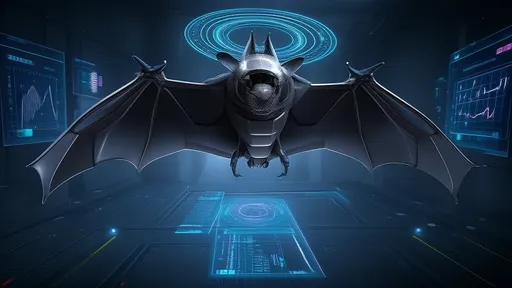
In the dimly lit world of echolocating bats, a remarkable biological sonar system operates with precision that puts human engineering to shame. These nocturnal creatures have evolved an elegant solution to a complex physics problem—how to maintain accurate echo perception while moving at high speeds. The phenomenon, known as Doppler shift compensation, reveals nature's ingenuity in calibrating flight navigation systems in real-time.
When a bat emits ultrasonic calls during flight, the returning echoes undergo frequency shifts due to the relative motion between the bat and its environment. This Doppler effect—the same phenomenon that makes an ambulance siren change pitch as it passes—would severely distort the bat's acoustic world if left uncorrected. Yet somehow, bats manage to interpret these shifting frequencies with flawless accuracy, adjusting their own vocalizations to compensate for the distortion.
The mechanics behind this compensation are nothing short of extraordinary. As a bat closes in on its prey, the echo's frequency increases proportionally to its flight speed. To counteract this, the bat lowers its subsequent call frequency by an equivalent amount, effectively stabilizing the perceived frequency of returning echoes. This biological feedback loop operates with millisecond precision, allowing bats to maintain a consistent acoustic reference frame even during complex aerial maneuvers.
Researchers using high-speed infrared cameras and ultrasonic microphones have documented bats performing these adjustments mid-flight. The animals demonstrate an ability to compensate for Doppler shifts exceeding 3 kHz—a substantial alteration given that their typical echolocation frequencies range between 20-100 kHz. What's more astonishing is that this compensation occurs while simultaneously processing spatial information, avoiding obstacles, and tracking evasive insects.
Neuroscientific investigations reveal specialized neural circuits dedicated to this compensation process. The bat's auditory system contains frequency-tuned neurons that compare emitted pulses with returning echoes. When discrepancies arise from Doppler shifts, these neural circuits trigger immediate adjustments in the vocal motor pathway. This creates a closed-loop system where auditory feedback directly influences vocal output—a biological implementation of what engineers would call an active control system.
The implications extend far beyond understanding bat behavior. Aerospace engineers studying autonomous drone navigation have drawn inspiration from these biological systems. Unlike man-made sonar that struggles with moving platforms, bats demonstrate how dynamic calibration can maintain sensor accuracy during rapid motion. Several research groups are now developing bio-inspired sonar systems that mimic the bat's Doppler compensation mechanisms.
Recent experiments with trained bats in wind tunnels have revealed additional layers of sophistication. The animals adjust their compensation strategies based on flight context—applying different correction parameters when chasing prey versus navigating through clutter. This contextual flexibility suggests that Doppler compensation isn't a rigid reflex, but rather a adaptable behavior modulated by cognitive processes.
Climate change research has unexpectedly benefited from these findings as well. Scientists monitoring bat populations as ecological indicators have discovered that Doppler compensation behaviors change with atmospheric conditions. The animals make subtle adjustments to their compensation algorithms in response to temperature, humidity, and air density variations—essentially recalibrating their sonar for different acoustic environments.
Conservation biologists are particularly interested in how light pollution might interfere with these sophisticated echolocation mechanisms. Preliminary evidence suggests that bats flying in artificially lit environments show less precise Doppler compensation, potentially explaining why some species avoid urban areas. This intersection of sensory biology and urban ecology could inform better wildlife-friendly lighting designs.
The evolutionary origins of Doppler compensation remain partially mysterious. Fossil evidence indicates that early echolocating bats from the Eocene epoch already possessed specialized ear structures, but whether they employed frequency compensation is unclear. Comparative studies with modern species suggest this ability may have co-evolved with high-speed flight capabilities, appearing approximately 30 million years ago when bats diversified into their modern ecological niches.
Technological applications continue to emerge from this research. Medical engineers are developing advanced hearing aids that mimic the bat's ability to separate overlapping frequencies—a challenge human hearing aids currently handle poorly. Meanwhile, automotive companies are testing collision avoidance systems that incorporate biological principles of dynamic frequency adjustment.
As research progresses, scientists are discovering that Doppler compensation represents just one component of an integrated sensory suite. Bats appear to combine this acoustic adjustment with visual cues, airflow sensing, and even magnetic field detection during navigation. This multimodal integration challenges traditional views of sensory systems operating in isolation, offering new paradigms for artificial intelligence and sensor fusion technologies.
The humble bat's solution to a complex physics problem continues to inspire innovations across multiple disciplines. From neuroscience to aerospace engineering, researchers find that nature's solutions to dynamical sensing challenges often surpass human-designed systems in both elegance and efficiency. As we unravel more mysteries of bat echolocation, we may discover even more sophisticated biological algorithms hidden in these nocturnal flyers.

By /Jul 7, 2025

By /Jul 7, 2025

By /Jul 7, 2025

By /Jul 7, 2025

By /Jul 7, 2025

By /Jul 7, 2025

By /Jul 7, 2025
By /Jul 7, 2025
By /Jul 7, 2025

By /Jul 7, 2025

By /Jul 7, 2025

By /Jul 7, 2025

By /Jul 7, 2025

By /Jul 7, 2025
By /Jul 7, 2025

By /Jul 7, 2025
By /Jul 7, 2025
By /Jul 7, 2025
